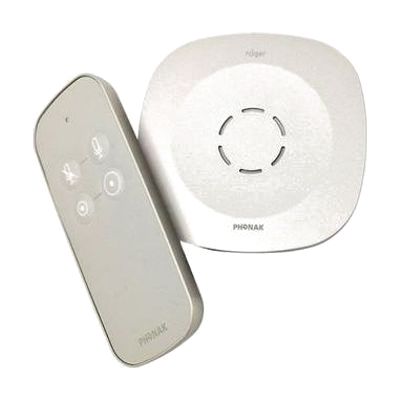
Phonak Roger Table Mic 3 | RogerDirect Compatible
by Phonak
Price is what the vendor listed when last checked. Confirm it with the vendor before buying.
Last verified September 16, 2026 · classified July 7, 2026
What it is
Summary
AI-generated from vendor-published content · July 7, 2026
The Roger Table Mic 3 is a wireless conference microphone that sits in the center of a meeting table and streams speech directly to compatible hearing aids or receivers — bypassing the distance and reverberation that make group conversations so difficult. It uses 360-degree beamforming to continuously track who's speaking, suppresses background noise automatically, and can link with other Roger mics across a larger space so no participant is out of range. This is a strong fit for someone with hearing loss who regularly attends staff meetings, team presentations, or small group settings where ambient noise and multiple talkers create real comprehension barriers. The mic streams via Phonak's Roger protocol, so it works natively with RogerDirect-enabled hearing aids without a receiver dongle — but non-RogerDirect aids require a Roger X receiver added to each hearing aid, which adds cost. At over $1,600, this is a significant investment, and the benefits depend heavily on the hearing aids already in use and whether receivers are needed on top.
Quick Facts Catalog facts · auto-generated
- AT Act lending
- Insurance
- Out of pocket
- Vocational rehab
What Setup Looks Like
- Out of the box
Power on the Table Mic 3 and pair it with RogerDirect-compatible hearing aids — the mic transmits immediately once connected. - With a guide
- For non-RogerDirect hearing aids, a Roger X receiver must be attached to each hearing aid before pairing.
- To set up a MultiTalker Network with additional Roger mics, follow Phonak's network pairing procedure in the manual — allow 15-30 minutes for a multi-device setup.
- See manufacturer support resources for detailed instructions.
- With professional help
- An audiologist or hearing aid specialist should confirm whether the user's current hearing aids support RogerDirect or require Roger X receivers.
- If receivers are needed, the audiologist attaches and programs them to the hearing aids — typically done at a regular clinic appointment.
Getting it
Try Before You Buy
Devices like this are often available to borrow through your state's AT Act program — typically free or low-cost — so you can try it before buying or pursuing funding.
Where to Get It
This is the vendor WhatCanHelp tracks for this product — it may also be available from other retailers or a local supplier, and prices vary.
Some links may be affiliate links — WhatCanHelp may earn a small commission from purchases at no extra cost to you. More on affiliates →
As an Amazon Associate we earn from qualifying purchases.
How to Fund This
Equipment like this is often pursued through official state programs. These are common starting points — each program decides its own eligibility and what it covers, so the first step is always a phone call.
Compare & explore
Sources & fine print
Vendor facts (name, price, platforms, vendor link) sourced from Phonak — view on vendor site; last verified September 16, 2026.
Classification & description AI-generated from vendor-published content on July 7, 2026 · confidence: high. Vendor specs may lag; verify before relying on details in a clinical or funding artifact.