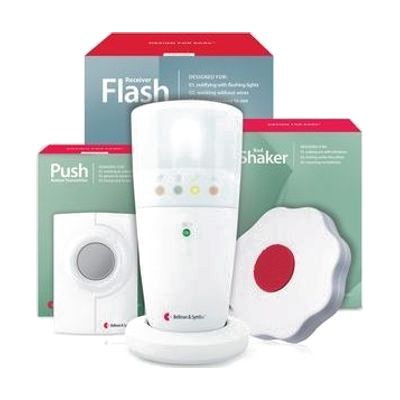
Push Notification ADA Compliance Kit with Flash Receiver
Last verified July 4, 2026 · classified July 7, 2026
What it is
Summary
AI-generated from vendor-published content · July 7, 2026
A three-piece wireless alerting kit — push button transmitter, strobe flash receiver, and bed shaker — designed for facilities that need to notify deaf or hard-of-hearing residents, guests, or clients when someone is at the door or calling for help. The push button can be mounted like a doorbell, worn as a personal call button, or placed at a service counter; pressing it triggers both a high-intensity visual strobe and strong bed vibration at the receiver end. This is a complete, ready-to-deploy package: all three units arrive factory-paired with no Wi-Fi, app, or manual setup required, which makes installation straightforward in hotel rooms, assisted living units, or multi-unit housing. The system addresses ADA-readiness for visitor notification and nighttime alerting, but it's a single-room configuration — facilities with many rooms will need to purchase multiple kits, as each transmitter communicates only to its pre-linked receiver set.
Quick Facts Catalog facts · auto-generated
- AT Act lending
- Medicaid waiver
- Out of pocket
What Setup Looks Like
- Out of the box
- Unbox all three units — Push Button Transmitter, Flash Receiver, and Bed Shaker are pre-linked at the factory.
- Plug the Flash Receiver into a wall outlet and connect the Bed Shaker to it.
- Mount or position the Push Button Transmitter at the door, bedside, or service counter.
- Press the button to confirm the strobe fires and bed shaker vibrates — system is operational.
- With a guide
- For permanent doorbell mounting, use the included hardware to secure the transmitter outside the unit door.
- Consult the Bellman setup guide for optional placement and signal-range considerations in larger rooms or concrete-wall buildings. See manufacturer support resources for detailed instructions.
Getting it
Try Before You Buy
Devices like this are often available to borrow through your state's AT Act program — typically free or low-cost — so you can try it before buying or pursuing funding.
Where to Get It
Some links may be affiliate links — WhatCanHelp may earn a small commission from purchases at no extra cost to you. More on affiliates →
How to Fund This
Equipment like this is often pursued through official state programs. These are common starting points — each program decides its own eligibility and what it covers, so the first step is always a phone call.
Compare & explore
Sources & fine print
Vendor facts (name, price, platforms, vendor link) sourced from Bellman & Symfon — view on vendor site; last verified July 4, 2026.
Classification & description AI-generated from vendor-published content on July 7, 2026 · confidence: high. Vendor specs may lag; verify before relying on details in a clinical or funding artifact.