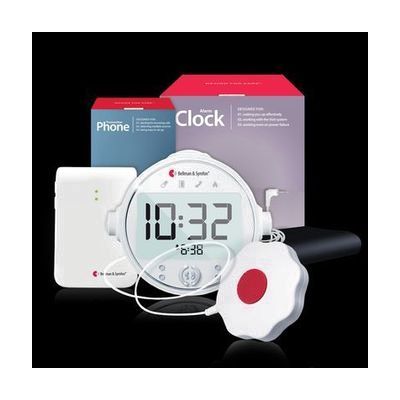
Entry Alert ADA Compliance Kit with Alarm Clock and Pressure Mat
Last verified June 16, 2026 · classified April 26, 2026
What it is
Summary
AI-generated from vendor-published content · April 26, 2026
This kit converts movement-based events — someone stepping on a pressure mat at a doorway or bedside — into visual flashes and bed vibration alerts that don't rely on hearing an audible sound. It's designed for two overlapping use cases: alerting a person who is deaf or hard of hearing when someone enters their space, and alerting caregivers or staff when a resident with dementia or fall risk leaves a bed or room. The package ships as a ready-to-deploy bundle including the pressure mat, a wireless transmitter, an alarm clock receiver with flashing display, and a bed shaker — all pre-paired from the factory with no Wi-Fi or app required. One honest consideration: this is a multi-component system covering one alert zone; facilities or homes needing coverage across multiple rooms or beds will need additional transmitters and receivers, which adds cost.
Quick Facts Catalog facts · auto-generated
- AT Act lending
- Insurance
- Medicaid waiver
- Out of pocket
What Setup Looks Like
- Out of the box
- Components arrive factory pre-linked — place the pressure mat at the target location (doorway or bedside), position the alarm clock receiver and bed shaker in the sleeping area, and power everything on.
- Test by stepping on the mat to confirm the receiver flashes and bed shaker activates — no pairing or app required.
- With a guide
- Review the included placement guide to choose between doorway-entry and bed-exit configurations.
- Connect the bed shaker to the alarm clock receiver's accessory port and route the cable appropriately for the sleeping environment.
- For facilities, map out which rooms need coverage and order additional transmitter/receiver pairs before installation — allow 30–60 minutes per room. See manufacturer support resources for detailed instructions.
- With professional help
- For ADA-compliance documentation in assisted living or memory care settings, consult a facilities accessibility coordinator or certified aging-in-place specialist (CAPS) to confirm placement meets applicable regulations.
- An occupational therapist (OT) can assess whether a bed-exit or door-entry configuration best matches the resident's specific wandering or safety profile.
Getting it
Try Before You Buy
Devices like this are often available to borrow through your state's AT Act program — typically free or low-cost — so you can try it before buying or pursuing funding.
Where to Get It
Some links may be affiliate links — WhatCanHelp may earn a small commission from purchases at no extra cost to you. More on affiliates →
As an Amazon Associate we earn from qualifying purchases.
How to Fund This
Equipment like this is often pursued through official state programs. These are common starting points — each program decides its own eligibility and what it covers, so the first step is always a phone call.
Compare & explore
Sources & fine print
Vendor facts (name, price, platforms, vendor link) sourced from Bellman & Symfon — view on vendor site; last verified June 16, 2026.
Classification & description AI-generated from vendor-published content on April 26, 2026 · confidence: high. Vendor specs may lag; verify before relying on details in a clinical or funding artifact.