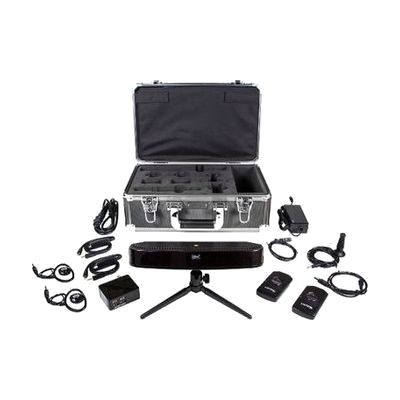
ListenIR iDSP Portable FM System
Price is what the vendor listed when last checked. Confirm it with the vendor before buying.
Last verified September 16, 2026 · classified April 26, 2026
What it is
Summary
AI-generated from vendor-published content · April 26, 2026
This is a portable infrared (IR) assistive listening system designed to broadcast audio — from a microphone, room sound system, or other source — directly to personal receivers worn by people with hearing loss. It's well-suited for courtrooms, classrooms, conference rooms, or any venue that needs to provide ADA-compliant assistive listening for up to 50 people without running wires across a room. The kit includes a transmitter-radiator unit, two receivers, neckloops, and ear speakers, so a small group can be served immediately out of the box — with additional receivers available separately for larger audiences. One important limitation: IR systems require line-of-sight and won't work well in bright sunlight or spaces with lots of natural light, making this a poor fit for outdoor use or sun-drenched atriums.
Quick Facts Catalog facts · auto-generated
- Insurance
- Out of pocket
- Vocational rehab
What Setup Looks Like
- Out of the box
- Unbox the transmitter-radiator, receivers, neckloops, and ear speakers — all included.
- Connect the transmitter to your audio source (microphone, room PA, or line-level input).
- Mount or position the radiator so it has line-of-sight coverage of the listening area.
- Distribute charged receivers with neckloops to listeners — they tune to the matching frequency and listen immediately.
- With a guide
- Download the Windows-compatible programming software from Listen Technologies to configure frequencies, name units, and track inventory.
- If expanding coverage, add up to four expansion radiators to the LT-84 transmitter (each adds ~30,000 sq ft of range).
- Plan radiator placement carefully to eliminate coverage gaps — consult the installation guide for optimal positioning. Allow 30–60 minutes for a first-time setup. See manufacturer support resources for detailed instructions.
- With professional help
- For permanent or large-venue installations, an AV integrator or hearing loop specialist can assess room layout, ceiling height, and ambient IR interference to ensure gapless coverage.
- Venues subject to ADA compliance audits may benefit from an assistive technology or accessibility consultant confirming the system meets IBC/ADA standards for their specific occupancy rating.
Getting it
Many states lend devices like this for free trial periods — find your state's AT lending program.
Where to Get It
This is the vendor WhatCanHelp tracks for this product — it may also be available from other retailers or a local supplier, and prices vary.
Some links may be affiliate links — WhatCanHelp may earn a small commission from purchases at no extra cost to you. More on affiliates →
As an Amazon Associate we earn from qualifying purchases.
How to Fund This
Equipment like this is often pursued through official state programs. These are common starting points — each program decides its own eligibility and what it covers, so the first step is always a phone call.
Compare & explore
Sources & fine print
Vendor facts (name, price, platforms, vendor link) sourced from Listen Technologies — view on vendor site; last verified September 16, 2026.
Classification & description AI-generated from vendor-published content on April 26, 2026 · confidence: high. Vendor specs may lag; verify before relying on details in a clinical or funding artifact.