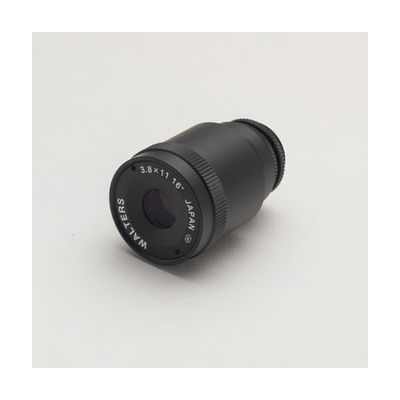
Walters 3.8x11 Monocular with 2 Lock Rings
by Walters
Price is what the vendor listed when last checked. Confirm it with the vendor before buying.
Last verified September 19, 2026 · classified May 9, 2026
What it is
Summary
AI-generated from vendor-published content · May 9, 2026
A compact 3.8x magnification monocular designed for people with low vision who need to view distant targets — street signs, whiteboards, menus, or faces across a room. At under an ounce and less than two inches long, it's small enough to carry in a pocket or wear on a neck strap. The 16-degree field of view is notably wide for a low vision monocular at this power, which makes it easier to locate targets before zooming in. It can be used handheld, but also mounts into spectacle frames, finger rings, or a stand — so an optometrist or low vision specialist can fit it as a bioptic or near-vision aid depending on the task. The two lock rings allow you to pre-set focus for a specific viewing distance, which is handy for repetitive tasks like reading a score sheet or cash register display. Comes ready to use handheld right away; spectacle mounting requires a low vision fitting appointment.
Quick Facts Catalog facts · auto-generated
- AT Act lending
- Out of pocket
- Vocational rehab
What Setup Looks Like
- Out of the box
- Remove from case, loop neck strap, and look through the eyepiece — focus by rotating the barrel until the image is sharp.
- Use the lock rings to secure the focus position for a frequently used distance.
- With professional help
- A low vision optometrist or optician can mount the monocular into a spectacle frame or clip for hands-free bioptic use.
- An orientation and mobility (O&M) specialist can train efficient spotting and scanning techniques for community use.
- Allow 1-3 clinical appointments for fitting and training. See manufacturer support resources for detailed instructions.
Getting it
Try Before You Buy
Devices like this are often available to borrow through your state's AT Act program — typically free or low-cost — so you can try it before buying or pursuing funding.
Where to Get It
This is the vendor WhatCanHelp tracks for this product — it may also be available from other retailers or a local supplier, and prices vary.
Some links may be affiliate links — WhatCanHelp may earn a small commission from purchases at no extra cost to you. More on affiliates →
As an Amazon Associate we earn from qualifying purchases.
How to Fund This
Equipment like this is often pursued through official state programs. These are common starting points — each program decides its own eligibility and what it covers, so the first step is always a phone call.
Compare & explore
Sources & fine print
Vendor facts (name, price, platforms, vendor link) sourced from Walters — view on vendor site; last verified September 19, 2026.
Classification & description AI-generated from vendor-published content on May 9, 2026 · confidence: high. Vendor specs may lag; verify before relying on details in a clinical or funding artifact.