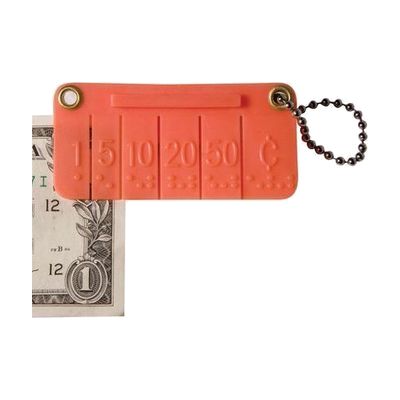
Paper Money Brailler
Price is what the vendor listed when last checked. Confirm it with the vendor before buying.
What it is
Summary
AI-generated from vendor-published content · October 1, 2026
The Paper Money Brailler lets someone who is blind or has low vision add braille marks to paper bills, so they can tell the denominations apart by touch. It works on $1, $5, $10, and $50 bills. The device is small, about 3 inches by 1.5 inches, and has a keychain attachment, so it can go with you in a pocket or bag. It's a stand-alone tool, with no batteries or other equipment mentioned.
Getting it
Try before you buy
Devices like this are often available to borrow through your state's AT Act program — typically free or low-cost — so you can try it before buying or pursuing funding.
Where to get it
This is the vendor WhatCanHelp tracks for this product — it may also be available from other retailers or a local supplier, and prices vary.
Wondering how equipment like this gets paid for? See the official funding programs in your state.
Details
Quick Facts Catalog facts · auto-generated
- Type
- Addresses
- Platform
- Age range
- Complexity
- Ready to use
- Price
- $6.45
- Funding
- AT Act lending
- Out of pocket
What setup looks like
- Out of the box
- Take it out of the package and use it right away to add braille to your paper bills.
- Clip it to a keychain if you want to carry it with you.
Compare & explore
Sources & fine print
Vendor facts (name, price, platforms, vendor link) sourced from LS&S — view on vendor site (opens in a new tab); last checked November 3, 2026.
Classification & description AI-generated from vendor-published content on October 1, 2026 · confidence: high. Vendor specs may lag; verify before relying on details in a clinical or funding artifact.