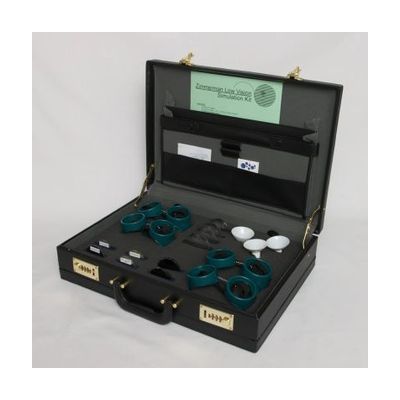
Zimmerman Low Vision Simulation Kit
Price is what the vendor listed when last checked. Confirm it with the vendor before buying.
Last verified September 20, 2026 · classified May 23, 2026
What it is
Summary
AI-generated from vendor-published content · May 23, 2026
This kit lets sighted people experience what vision looks like under 11 different eye conditions — including cataracts, macular degeneration, tunnel vision, hemianopsia, and varying levels of acuity loss from 20/70 to 20/800. It's designed for O&M instructors, rehabilitation specialists, low vision educators, and eye care professionals who need to help sighted colleagues, students, or family members understand what their clients actually see. The kit contains four pairs of welding-style goggles with graduated acuity lenses, three peripheral field restriction funnels, and several interchangeable lenses, all packed in a hard-sided attaché case. This is a training and advocacy tool, not something worn by people who have low vision — it's only useful if someone is running education sessions or professional training, and the simulations are approximations, not clinically precise replications of any individual's vision.
Quick Facts Catalog facts · auto-generated
- Out of pocket
- Vocational rehab
What Setup Looks Like
- Out of the box
- Open the attaché case and select the lens or funnel that corresponds to the condition you want to simulate.
- Attach the selected lens or funnel to the appropriate goggles and have the participant put them on.
- With a guide
- Review the included documentation to understand which lens/funnel combination simulates which condition.
- Plan a structured activity or environment walk-through so participants experience practical impacts, not just static viewing — 30–60 minutes to design a meaningful session.
Getting it
Many states lend devices like this for free trial periods — find your state's AT lending program.
Where to Get It
This is the vendor WhatCanHelp tracks for this product — it may also be available from other retailers or a local supplier, and prices vary.
Some links may be affiliate links — WhatCanHelp may earn a small commission from purchases at no extra cost to you. More on affiliates →
As an Amazon Associate we earn from qualifying purchases.
How to Fund This
Equipment like this is often pursued through official state programs. These are common starting points — each program decides its own eligibility and what it covers, so the first step is always a phone call.
Compare & explore
Sources & fine print
Vendor facts (name, price, platforms, vendor link) sourced from Independent Living Aids — view on vendor site; last verified September 20, 2026.
Classification & description AI-generated from vendor-published content on May 23, 2026 · confidence: high. Vendor specs may lag; verify before relying on details in a clinical or funding artifact.