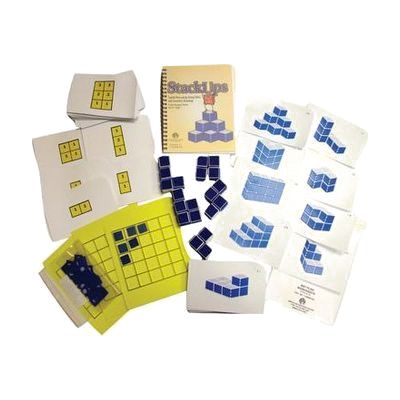
StackUps Kit: Spatial Reasoning Using Cubes and Isometric Drawings
by American Printing House for the Blind
Last verified June 15, 2026 · classified May 23, 2026
What it is
Summary
AI-generated from vendor-published content · May 23, 2026
This hands-on kit teaches students who are blind or have low vision to understand isometric and orthographic drawings — the kind of 2D representations of 3D cube arrangements commonly found in math and spatial reasoning curricula. Students work with actual cubes to build structures, then learn to interpret the corresponding raised-line tactile graphics that represent those same structures from multiple angles. It's designed for the gap between tactile learning and abstract 2D graphic literacy, a skill that sighted students typically develop through visual exposure but that students with visual impairments rarely get systematic instruction on. The kit is a complete instructional resource — cubes, tactile graphic cards, and supporting materials — but it's meant to be used with a teacher of students with visual impairments (TVI) or a paraprofessional who can guide the lessons. Not a self-directed student tool; the pedagogical sequence matters and an instructor familiar with tactile graphics instruction will get much more out of it.
Quick Facts Catalog facts · auto-generated
- AT Act lending
- Out of pocket
- School district
What Setup Looks Like
- Out of the box
Open the kit and explore the physical cube manipulatives and tactile graphic cards — no assembly required. - With a guide
- Review the instructor materials to understand the lesson sequence connecting physical cube structures to their raised-line representations.
- Organize materials by lesson module before beginning instruction — plan approximately 30 minutes per session.
- With professional help
- A teacher of students with visual impairments (TVI) should lead instruction, selecting which graphic representations to introduce based on the student's current tactile literacy level.
- Coordinate with the student's math teacher to align spatial reasoning lessons with grade-level curriculum objectives.
- See manufacturer support resources for detailed instructions.
Getting it
Try Before You Buy
Devices like this are often available to borrow through your state's AT Act program — typically free or low-cost — so you can try it before buying or pursuing funding.
Where to Get It
Some links may be affiliate links — WhatCanHelp may earn a small commission from purchases at no extra cost to you. More on affiliates →
Wondering how equipment like this gets paid for? See the official funding programs in your state.
Compare & explore
Sources & fine print
Vendor facts (name, price, platforms, vendor link) sourced from American Printing House for the Blind — view on vendor site; last verified June 15, 2026.
Classification & description AI-generated from vendor-published content on May 23, 2026 · confidence: high. Vendor specs may lag; verify before relying on details in a clinical or funding artifact.