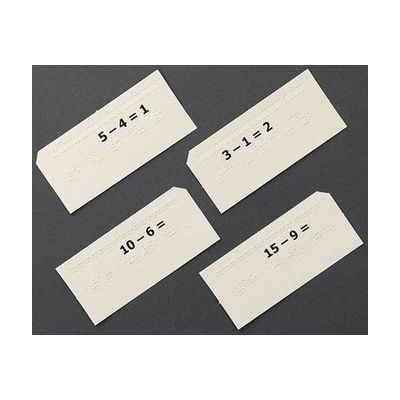
Math Drill Cards: Subtraction Facts (UEB)
by American Printing House for the Blind
Price is what the vendor listed when last checked. Confirm it with the vendor before buying.
Last verified September 17, 2026 · classified May 23, 2026
What it is
Summary
AI-generated from vendor-published content · May 23, 2026
These are physical flashcards for subtraction facts printed in both large print and Unified English Braille (UEB), designed for students who are blind or have low vision and are learning basic math. Each card shows a subtraction problem on one side and the same problem with its answer on the reverse — the same self-check format sighted students use with standard flashcards, just accessible. This is a complete, ready-to-use learning tool that needs no setup beyond organizing the deck. They're compatible with APH's Card Chart Kit if you want a structured display system, but that's optional.
Quick Facts Catalog facts · auto-generated
- AT Act lending
- Out of pocket
- School district
What Setup Looks Like
- Out of the box
Sort cards as needed and begin drilling — problem on front, flip for answer on back. - With a guide
- Pair with the APH Card Chart Kit (sold separately) for organized, grid-based practice sessions.
- A teacher or TVI can sequence cards by fact family or difficulty to match the student's IEP math goals — typically done in a single planning session.
Getting it
Try Before You Buy
Devices like this are often available to borrow through your state's AT Act program — typically free or low-cost — so you can try it before buying or pursuing funding.
Where to Get It
This is the vendor WhatCanHelp tracks for this product — it may also be available from other retailers or a local supplier, and prices vary.
Some links may be affiliate links — WhatCanHelp may earn a small commission from purchases at no extra cost to you. More on affiliates →
As an Amazon Associate we earn from qualifying purchases.
Wondering how equipment like this gets paid for? See the official funding programs in your state.
Compare & explore
Sources & fine print
Vendor facts (name, price, platforms, vendor link) sourced from American Printing House for the Blind — view on vendor site; last verified September 17, 2026.
Classification & description AI-generated from vendor-published content on May 23, 2026 · confidence: high. Vendor specs may lag; verify before relying on details in a clinical or funding artifact.