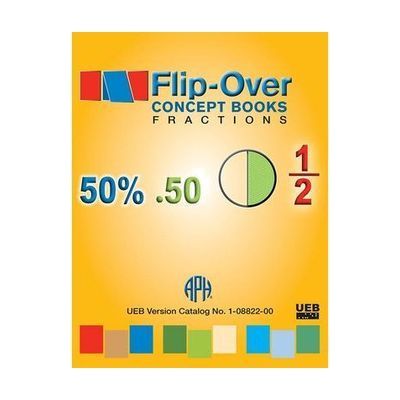
Flip-Over Concept Books - Fractions: UEB
by American Printing House for the Blind
Last verified June 15, 2026 · classified May 23, 2026
What it is
Summary
AI-generated from vendor-published content · May 23, 2026
A tactile and braille teaching manipulative designed to help students who are blind or have low vision explore fraction concepts through hands-on interaction. The flip-over format uses panels that can be rearranged by teachers or parents to build custom lessons — covering part-to-whole relationships, equivalent fractions, and the connections between fractions, decimals, and percentages. Text is formatted in Unified English Braille (UEB), so students read the labels directly rather than relying on a sighted intermediary. This is a teaching tool, not a standalone curriculum — it works best alongside other APH math materials and direct instruction from a teacher of the visually impaired (TVI) or classroom teacher familiar with tactile math tools.
Quick Facts Catalog facts · auto-generated
- AT Act lending
- Out of pocket
- School district
- Vocational rehab
What Setup Looks Like
- Out of the box
Open the book and begin presenting fraction panels in any order to suit the current lesson topic. - With professional help
- A teacher of the visually impaired (TVI) or math educator integrates this into structured fraction lessons, selecting panel sequences to match IEP goals or curriculum scope.
- Allow 1-2 planning sessions to align panel use with the student's current math level and other APH manipulatives in use.
- See manufacturer support resources for detailed instructions.
Getting it
Try Before You Buy
Devices like this are often available to borrow through your state's AT Act program — typically free or low-cost — so you can try it before buying or pursuing funding.
Where to Get It
Some links may be affiliate links — WhatCanHelp may earn a small commission from purchases at no extra cost to you. More on affiliates →
How to Fund This
Equipment like this is often pursued through official state programs. These are common starting points — each program decides its own eligibility and what it covers, so the first step is always a phone call.
Compare & explore
Sources & fine print
Vendor facts (name, price, platforms, vendor link) sourced from American Printing House for the Blind — view on vendor site; last verified June 15, 2026.
Classification & description AI-generated from vendor-published content on May 23, 2026 · confidence: high. Vendor specs may lag; verify before relying on details in a clinical or funding artifact.