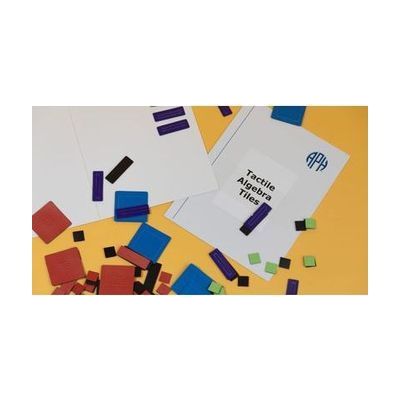
Tactile Algebra Tiles
by American Printing House for the Blind
Last verified July 30, 2026 · classified May 23, 2026
What it is
Summary
AI-generated from vendor-published content · May 23, 2026
These are magnetic, tactilely-differentiated algebra tiles designed for students with visual impairments who are learning algebraic concepts like factoring, completing the square, and polynomial operations. Each tile has a distinct raised texture or shape so that students who cannot rely on color alone can identify tile values and types by touch, while sighted or low-vision students can use the color coding simultaneously. The tiles work on a steel magnetic board, keeping pieces in place during manipulation — a meaningful advantage over loose tiles that shift unpredictably. This is a complete hands-on manipulative kit, not software or an add-on to another system, though it works best when introduced by a teacher of the visually impaired (TVI) or a math teacher familiar with algebra tile instruction methods. The steel board is included, but classroom integration still requires someone who knows how to use manipulative-based algebra instruction.
Quick Facts Catalog facts · auto-generated
- AT Act lending
- Out of pocket
- School district
- Vocational rehab
What Setup Looks Like
- Out of the box
Place the steel board on a flat surface and begin arranging tiles by shape/texture to represent algebraic expressions. - With a guide
- Review the included guide to understand tile value assignments and how to set up common problem types.
- Practice arranging tiles for basic expressions before introducing factoring or polynomial operations — expect 15–30 minutes of orientation.
- With professional help
- A teacher of the visually impaired (TVI) or math specialist should introduce tactile labeling conventions and correlate tile types to the student's existing braille or large-print math curriculum.
- Coordinate with the student's math teacher to align manipulative use with classroom instruction. See manufacturer support resources for detailed instructions.
Getting it
Try Before You Buy
Devices like this are often available to borrow through your state's AT Act program — typically free or low-cost — so you can try it before buying or pursuing funding.
Where to Get It
This is the vendor WhatCanHelp tracks for this product — it may also be available from other retailers or a local supplier, and prices vary.
Some links may be affiliate links — WhatCanHelp may earn a small commission from purchases at no extra cost to you. More on affiliates →
As an Amazon Associate we earn from qualifying purchases.
How to Fund This
Equipment like this is often pursued through official state programs. These are common starting points — each program decides its own eligibility and what it covers, so the first step is always a phone call.
Compare & explore
Sources & fine print
Vendor facts (name, price, platforms, vendor link) sourced from American Printing House for the Blind — view on vendor site; last verified July 30, 2026.
Classification & description AI-generated from vendor-published content on May 23, 2026 · confidence: high. Vendor specs may lag; verify before relying on details in a clinical or funding artifact.