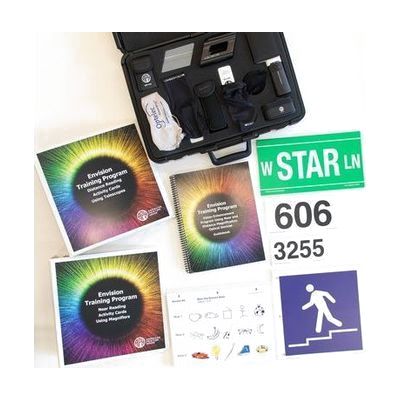
Envision Kit with Optical Aids
by American Printing House for the Blind
Last verified July 3, 2026 · classified July 6, 2026
What it is
Summary
AI-generated from vendor-published content · July 6, 2026
This is a structured training curriculum that teaches people with low vision how to actually use their optical aids — things like hand-held magnifiers, stand magnifiers, and telescopes — across the kinds of real-world tasks they encounter daily. The kit includes practice materials like price tags, medicine labels, maps, nutritional labels, coupons, and puzzles, so learners build skill in context rather than in the abstract. It's designed for someone who has been prescribed an optical device but hasn't yet developed the visual efficiency skills to use it effectively — a gap that's extremely common and often overlooked. This is a teaching tool and practice curriculum, not a magnification device itself; you need existing optical aids to use it with. Vision rehabilitation therapists and orientation & mobility specialists will get the most out of this as a structured program, though motivated adults with guidance from a low vision clinic could work through portions independently.
Quick Facts Catalog facts · auto-generated
- AT Act lending
- Out of pocket
- Vocational rehab
What Setup Looks Like
- Out of the box
Review included materials to understand the curriculum structure and lesson sequence. - With a guide
- Identify which optical devices the learner already has (hand magnifiers, telescopes, etc.).
- Work through lessons in sequence, matching tasks to the environments described in the kit — allow 4-8 sessions depending on learner pace.
- See manufacturer support resources for detailed instructions.
- With professional help
- A vision rehabilitation therapist (VRT) or low vision specialist should conduct an initial assessment to identify which optical devices the learner is using and set appropriate lesson goals.
- Integrate kit lessons into a broader low vision rehabilitation program — typically 4-10 sessions over several weeks.
Getting it
Try Before You Buy
Devices like this are often available to borrow through your state's AT Act program — typically free or low-cost — so you can try it before buying or pursuing funding.
Where to Get It
Some links may be affiliate links — WhatCanHelp may earn a small commission from purchases at no extra cost to you. More on affiliates →
How to Fund This
Equipment like this is often pursued through official state programs. These are common starting points — each program decides its own eligibility and what it covers, so the first step is always a phone call.
Compare & explore
Sources & fine print
Vendor facts (name, price, platforms, vendor link) sourced from American Printing House for the Blind — view on vendor site; last verified July 3, 2026.
Classification & description AI-generated from vendor-published content on July 6, 2026 · confidence: high. Vendor specs may lag; verify before relying on details in a clinical or funding artifact.