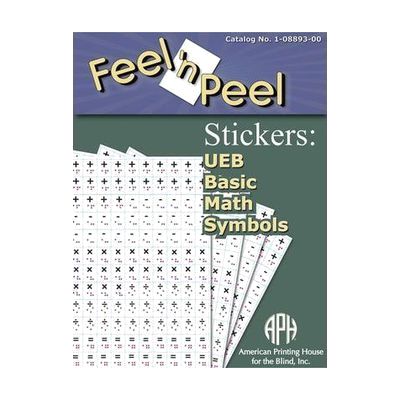
Feel 'n Peel Stickers: UEB Basic Math Symbols
by American Printing House for the Blind
Price is what the vendor listed when last checked. Confirm it with the vendor before buying.
Last verified September 17, 2026 · classified July 6, 2026
What it is
Summary
AI-generated from vendor-published content · July 6, 2026
These are tactile-visual sticker sheets containing braille and raised-symbol versions of basic math symbols formatted in Unified English Braille (UEB) — things like plus, minus, equals, and multiplication signs. Students who are blind or have low vision can peel them off and apply them to worksheets, notebooks, or tactile graphics to label math materials accessibly. This is a consumable supply item, not a complete solution — you'll still need appropriate math curricula and likely a teacher or TVI (Teacher of Students with Visual Impairments) to incorporate them meaningfully into instruction. The stickers are Federal Quota eligible, meaning schools serving students with visual impairments can often obtain them through APH's quota allotment rather than paying out of pocket.
Quick Facts Catalog facts · auto-generated
- AT Act lending
- Out of pocket
- School district
What Setup Looks Like
- Out of the box
Peel a sticker and apply it to any flat surface — worksheets, notebooks, tactile graphics, or learning materials. - With professional help
A Teacher of Students with Visual Impairments (TVI) integrates the stickers into braille math instruction aligned with the student's UEB curriculum goals.
Getting it
Try Before You Buy
Devices like this are often available to borrow through your state's AT Act program — typically free or low-cost — so you can try it before buying or pursuing funding.
Where to Get It
This is the vendor WhatCanHelp tracks for this product — it may also be available from other retailers or a local supplier, and prices vary.
Some links may be affiliate links — WhatCanHelp may earn a small commission from purchases at no extra cost to you. More on affiliates →
As an Amazon Associate we earn from qualifying purchases.
Wondering how equipment like this gets paid for? See the official funding programs in your state.
Compare & explore
Sources & fine print
Vendor facts (name, price, platforms, vendor link) sourced from American Printing House for the Blind — view on vendor site; last verified September 17, 2026.
Classification & description AI-generated from vendor-published content on July 6, 2026 · confidence: high. Vendor specs may lag; verify before relying on details in a clinical or funding artifact.