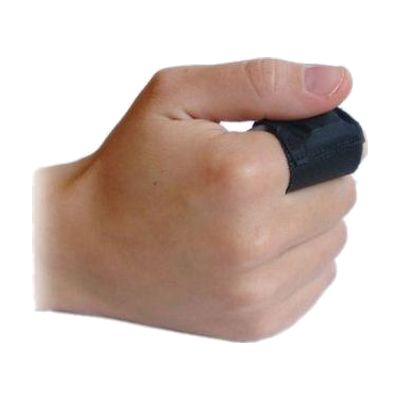
FingerButton Switch
by AbleNet
Last verified June 20, 2026 · classified April 26, 2026
What it is
Summary
AI-generated from vendor-published content · April 26, 2026
The FingerButton Switch is a small switch that wraps around a finger and activates with a light press, sending a signal to switch-accessible devices like AAC systems, computers, or powered equipment. It's designed for someone who has very limited hand strength or range of motion but can manage a small finger movement — the kind of situation where a larger tabletop switch is too hard to reach or requires too much force. This is just the switch itself: you'll need a compatible switch-accessible device and the right cable (3.5mm standard) to connect it, and the dual version requires a Y-cable splitter sold separately to control two functions independently. The finger-mounted form factor is clever but takes some trial and error to position correctly, and users with significantly reduced finger sensation may find consistent activation tricky.
Quick Facts Catalog facts · auto-generated
- AT Act lending
- Medicaid waiver
- Out of pocket
- School district
- Vocational rehab
What Setup Looks Like
- Out of the box
- Wrap the switch around the target finger using the included band.
- Plug the 3.5mm cable into your switch-accessible device and test activation.
- With professional help
- An occupational therapist (OT) or assistive technology professional (ATP) can assess which finger and hand position gives the most reliable and fatigue-free activation.
- For dual-switch use with a Y-cable splitter, an ATP can configure the connected device to map each switch to the correct function — expect 1-2 sessions. See manufacturer support resources for detailed instructions.
Getting it
Try Before You Buy
Devices like this are often available to borrow through your state's AT Act program — typically free or low-cost — so you can try it before buying or pursuing funding.
Where to Get It
Some links may be affiliate links — WhatCanHelp may earn a small commission from purchases at no extra cost to you. More on affiliates →
As an Amazon Associate we earn from qualifying purchases.
How to Fund This
Equipment like this is often pursued through official state programs. These are common starting points — each program decides its own eligibility and what it covers, so the first step is always a phone call.
Compare & explore
Sources & fine print
Vendor facts (name, price, platforms, vendor link) sourced from AbleNet — view on vendor site; last verified June 20, 2026.
Classification & description AI-generated from vendor-published content on April 26, 2026 · confidence: high. Vendor specs may lag; verify before relying on details in a clinical or funding artifact.