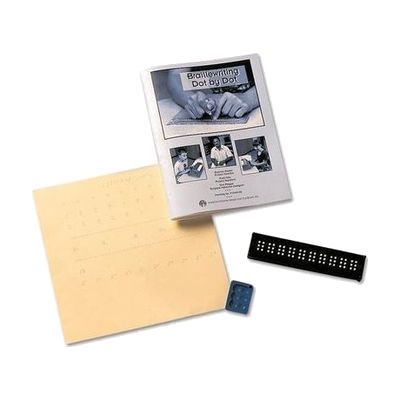
Braillewriting Dot by Dot Kit with Print Teacher's Manual
by American Printing House for the Blind
Last verified June 15, 2026 · classified May 23, 2026
What it is
Summary
AI-generated from vendor-published content · May 23, 2026
This curriculum kit teaches students who are blind or have low vision how to physically produce braille — using both a braillewriter (a mechanical device similar to a typewriter) and a slate and stylus (a manual tool for embossing dots). Most early braille instruction focuses on reading; this kit specifically addresses the writing side, building the motor skills and dot-pattern knowledge needed to create braille independently. It comes with a print teacher's manual, so a sighted educator or vision specialist can guide instruction without needing to read braille themselves. This is a structured teaching toolkit, not a standalone resource — it's designed for use within a classroom or intervention setting led by a Teacher of the Visually Impaired (TVI). The slate and stylus method in particular has a notable learning curve, since it requires writing mirror-image dot patterns from right to left.
Quick Facts Catalog facts · auto-generated
- AT Act lending
- Out of pocket
- School district
- Vocational rehab
What Setup Looks Like
- Out of the box
Open the kit and review the print teacher's manual to understand the lesson sequence and required materials. - With a guide
- Identify whether the student has access to a braillewriter (e.g., Perkins Brailler) and a slate and stylus — both are needed but may not be included in the kit.
- Follow the lesson sequence in the manual, starting with individual dot placement before progressing to full cell patterns.
- Plan for multiple sessions over several weeks; early writing lessons typically require 15–30 minutes of guided practice each. See manufacturer support resources for detailed instructions.
- With professional help
- A Teacher of the Visually Impaired (TVI) should assess the student's current braille readiness and integrate this curriculum into the student's IEP goals.
- Ongoing TVI sessions are typically needed to correct technique with both the braillewriter and slate, especially for slate and stylus use.
Getting it
Try Before You Buy
Devices like this are often available to borrow through your state's AT Act program — typically free or low-cost — so you can try it before buying or pursuing funding.
Where to Get It
Some links may be affiliate links — WhatCanHelp may earn a small commission from purchases at no extra cost to you. More on affiliates →
How to Fund This
Equipment like this is often pursued through official state programs. These are common starting points — each program decides its own eligibility and what it covers, so the first step is always a phone call.
Compare & explore
Sources & fine print
Vendor facts (name, price, platforms, vendor link) sourced from American Printing House for the Blind — view on vendor site; last verified June 15, 2026.
Classification & description AI-generated from vendor-published content on May 23, 2026 · confidence: high. Vendor specs may lag; verify before relying on details in a clinical or funding artifact.