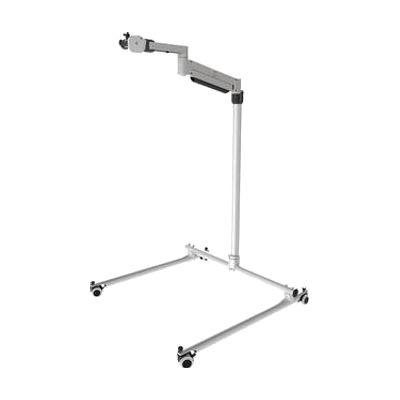
REHAdapt OneHand HD Floor Stand
by REHAdapt
Price is what the vendor listed when last checked. Confirm it with the vendor before buying.
Last verified September 16, 2026 · classified May 23, 2026
What it is
Summary
AI-generated from vendor-published content · May 23, 2026
A heavy-duty floor stand designed to hold larger AT devices — think All-in-One touch PCs, eye gaze systems, or robust AAC equipment — in a stable, repositionable position without needing tools to adjust. The OneHand HD arm locks into position with one hand, making it practical in clinical or home settings where the device needs to move between users or locations. This is not a complete solution on its own: it requires a REHAdapt mounting plate (sold separately) matched to the specific device being mounted, so budget and plan for that additional component. The base spans 110cm wide for stability, reaches up to 120cm height — which suits most seated users but may fall short for standing-height access — and handles loads of 6–11kg.
Quick Facts Catalog facts · auto-generated
- AT Act lending
- Medicaid waiver
- Out of pocket
- School district
- Vocational rehab
What Setup Looks Like
- With a guide
- Identify and order the correct REHAdapt mounting plate for your specific device (sold separately).
- Assemble the floor stand base and attach the HD mounting arm — no tools required for arm adjustments.
- Attach the mounting plate and device to the arm, then adjust height and angle to the user's position.
- Allow 2–3 weeks for delivery before scheduling setup. See manufacturer support resources for detailed instructions.
- With professional help
- An occupational therapist (OT) or ATP should determine optimal device positioning relative to the user's seating and postural support.
- Incorrect height or angle for AAC or eye gaze systems can significantly affect access accuracy — a positioning session with the user's AT team is strongly recommended.
Getting it
Try Before You Buy
Devices like this are often available to borrow through your state's AT Act program — typically free or low-cost — so you can try it before buying or pursuing funding.
Where to Get It
This is the vendor WhatCanHelp tracks for this product — it may also be available from other retailers or a local supplier, and prices vary.
Some links may be affiliate links — WhatCanHelp may earn a small commission from purchases at no extra cost to you. More on affiliates →
As an Amazon Associate we earn from qualifying purchases.
How to Fund This
Equipment like this is often pursued through official state programs. These are common starting points — each program decides its own eligibility and what it covers, so the first step is always a phone call.
Compare & explore
Sources & fine print
Vendor facts (name, price, platforms, vendor link) sourced from REHAdapt — view on vendor site; last verified September 16, 2026.
Classification & description AI-generated from vendor-published content on May 23, 2026 · confidence: high. Vendor specs may lag; verify before relying on details in a clinical or funding artifact.