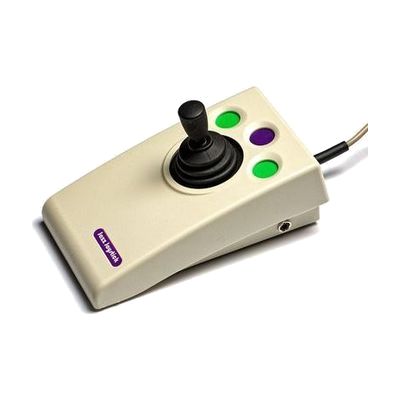
JAZZ Joystick
Price is what the vendor listed when last checked. Confirm it with the vendor before buying.
Last verified September 16, 2026 · classified April 26, 2026
What it is
Summary
AI-generated from vendor-published content · April 26, 2026
The JAZZ Joystick is a compact, low-profile joystick that replaces a standard mouse for people who find precise mouse control difficult — it translates gross hand and wrist movements into cursor movement on screen. It's designed for people with limited fine motor control, such as those with cerebral palsy, muscular dystrophy, or upper limb differences, who can manage gross arm or hand movements but struggle with the precision a standard mouse demands. The package includes three interchangeable knob styles (acorn, T-bar, and foam ball) and two 3.5mm switch jacks, so it can be customized to match a user's grip and can also operate as a switch scanning controller — making it a fairly complete alternative input solution rather than a single-purpose peripheral. Finding the right knob, cursor speed setting, and switch configuration typically takes some trial and experimentation, and an OT or ATP can save significant time dialing in the setup for best results.
Quick Facts Catalog facts · auto-generated
- AT Act lending
- Out of pocket
- School district
- Vocational rehab
What Setup Looks Like
- Out of the box
- Plug the USB connector into any computer — no software installation required.
- Select one of four cursor speed settings using the onboard control.
- Attach your preferred joystick knob (acorn, T-bar, or foam ball) to suit your grip.
- With a guide
- Review Inclusive Technology's setup documentation to configure left-hand mode, drag function, and double-click settings.
- Toggle between Mouse mode and Switch Scanning mode as needed for your workflow.
- Connect external switches to the 3.5mm jacks if left/right click or mode-toggle via switch is required — allow 30–60 minutes to test and settle on a configuration. See manufacturer support resources for detailed instructions.
- With professional help
- An occupational therapist (OT) or assistive technology professional (ATP) should assess the user's range of motion, strength, and positioning to select the optimal knob and cursor speed.
- If switch scanning integration is needed, an SLP or ATP familiar with scanning access should configure mode settings and integrate with the user's AAC or software environment — expect 1–2 assessment sessions.
Getting it
Try Before You Buy
Devices like this are often available to borrow through your state's AT Act program — typically free or low-cost — so you can try it before buying or pursuing funding.
Where to Get It
This is the vendor WhatCanHelp tracks for this product — it may also be available from other retailers or a local supplier, and prices vary.
Some links may be affiliate links — WhatCanHelp may earn a small commission from purchases at no extra cost to you. More on affiliates →
As an Amazon Associate we earn from qualifying purchases.
How to Fund This
Equipment like this is often pursued through official state programs. These are common starting points — each program decides its own eligibility and what it covers, so the first step is always a phone call.
Compare & explore
Sources & fine print
Vendor facts (name, price, platforms, vendor link) sourced from Inclusive Technology — view on vendor site; last verified September 16, 2026.
Classification & description AI-generated from vendor-published content on April 26, 2026 · confidence: high. Vendor specs may lag; verify before relying on details in a clinical or funding artifact.