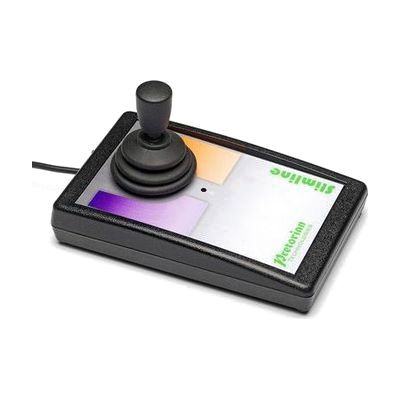
Slimline Joystick
Price is what the vendor listed when last checked. Confirm it with the vendor before buying.
Last verified September 16, 2026 · classified April 26, 2026
What it is
Summary
AI-generated from vendor-published content · April 26, 2026
The Slimline Joystick is a compact USB joystick designed to replace a standard mouse for people who struggle with the fine motor control required for conventional pointing devices. It's sized for smaller hands — children especially, but also adults with limited hand strength or dexterity — and includes a low-profile palm rest to reduce fatigue during longer use. It ships with two handle options (a T-bar and a sponge ball), four adjustable cursor speed settings, and two 3.5mm switch jacks so external switches can substitute for the touch-sensitive buttons if needed. This is a plug-and-play device that works across Windows, Mac, and iOS/iPadOS without installing drivers, but getting the speed settings and button assignments right for a specific user will usually benefit from trial and experimentation — ideally with an occupational therapist or ATP who can assess handle choice, switch setup, and mounting options.
Quick Facts Catalog facts · auto-generated
- AT Act lending
- Medicaid waiver
- Out of pocket
- School district
- Vocational rehab
What Setup Looks Like
- Out of the box
- Plug the USB connector into a computer, Mac, or iPad (via adapter) — the joystick is recognized automatically with no driver installation.
- Select preferred handle (T-bar or sponge ball) by attaching to the joystick shaft.
- Use the cursor speed selector to choose from four speed settings based on user comfort.
- With a guide
- Program the touch-sensitive buttons for left click, right click, double-click, or drag-lock using the button configuration options.
- Connect external switches to the two 3.5mm sockets to replace touch buttons if the user cannot activate them reliably.
- Test handle options and speed settings across typical tasks — allow 30–60 minutes to find a workable baseline configuration. See manufacturer support resources for detailed instructions.
- With professional help
- An occupational therapist (OT) or assistive technology professional (ATP) can assess which handle, cursor speed, and button mapping best match the user's motor profile.
- If paired with switch scanning or AAC software, an SLP or ATP should configure the integration — plan for 1–2 sessions.
Getting it
Try Before You Buy
Devices like this are often available to borrow through your state's AT Act program — typically free or low-cost — so you can try it before buying or pursuing funding.
Where to Get It
This is the vendor WhatCanHelp tracks for this product — it may also be available from other retailers or a local supplier, and prices vary.
Some links may be affiliate links — WhatCanHelp may earn a small commission from purchases at no extra cost to you. More on affiliates →
As an Amazon Associate we earn from qualifying purchases.
How to Fund This
Equipment like this is often pursued through official state programs. These are common starting points — each program decides its own eligibility and what it covers, so the first step is always a phone call.
Compare & explore
Sources & fine print
Vendor facts (name, price, platforms, vendor link) sourced from Inclusive Technology — view on vendor site; last verified September 16, 2026.
Classification & description AI-generated from vendor-published content on April 26, 2026 · confidence: high. Vendor specs may lag; verify before relying on details in a clinical or funding artifact.