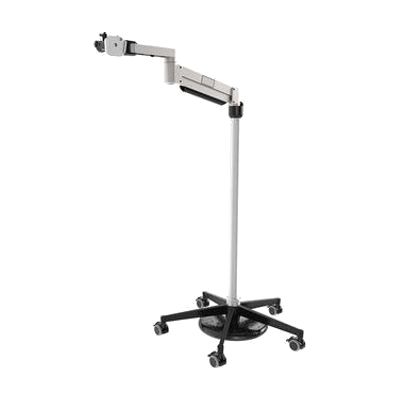
REHAdapt PentaFloat Eco Rolling Floor Stand
by REHAdapt
Price is what the vendor listed when last checked. Confirm it with the vendor before buying.
Last verified September 16, 2026 · classified April 26, 2026
What it is
Summary
AI-generated from vendor-published content · April 26, 2026
The PentaFloat Eco is a compact rolling floor stand designed to hold lightweight AAC devices, tablets, and communication aids in a stable, adjustable position without needing to lock the arm in place — the free-floating articulated arm moves smoothly and stays where you put it. It's a good fit for someone who needs a device positioned at a precise angle bedside, next to a sofa, or near a wheelchair but doesn't have a suitable surface or wheelchair mount available. You get the stand and arm, but you'll need to purchase a REHAdapt mounting plate separately to actually attach your device — the stand alone won't hold anything. The load capacity tops out at 3kg (about 6.6 lbs), so it's limited to lighter devices like iPads and small AAC devices; heavier eye-gaze systems or larger SGDs will need a different stand.
Quick Facts Catalog facts · auto-generated
- AT Act lending
- Medicaid waiver
- Out of pocket
- School district
- Vocational rehab
What Setup Looks Like
- Out of the box
Roll the stand into position near the user's seating area — the five-star wheeled base moves without tools. - With a guide
- Purchase the correct REHAdapt mounting plate for your specific device separately before setup.
- Attach the mounting plate to the device and connect to the UDS Quick Release system on the arm.
- Adjust the articulated arm angle to the user's preferred viewing position — no locks required, roughly 15–30 minutes with documentation.
- See manufacturer support resources for detailed instructions.
- With professional help
- An occupational therapist (OT) or ATP should assess optimal device height, angle, and placement relative to the user's seating position for best access.
- If paired with eye-gaze or switch access, an SLP or ATP should verify positioning meets the access requirements of the system — expect 1 session.
Getting it
Try Before You Buy
Devices like this are often available to borrow through your state's AT Act program — typically free or low-cost — so you can try it before buying or pursuing funding.
Where to Get It
This is the vendor WhatCanHelp tracks for this product — it may also be available from other retailers or a local supplier, and prices vary.
Some links may be affiliate links — WhatCanHelp may earn a small commission from purchases at no extra cost to you. More on affiliates →
As an Amazon Associate we earn from qualifying purchases.
How to Fund This
Equipment like this is often pursued through official state programs. These are common starting points — each program decides its own eligibility and what it covers, so the first step is always a phone call.
Compare & explore
Sources & fine print
Vendor facts (name, price, platforms, vendor link) sourced from REHAdapt — view on vendor site; last verified September 16, 2026.
Classification & description AI-generated from vendor-published content on April 26, 2026 · confidence: high. Vendor specs may lag; verify before relying on details in a clinical or funding artifact.