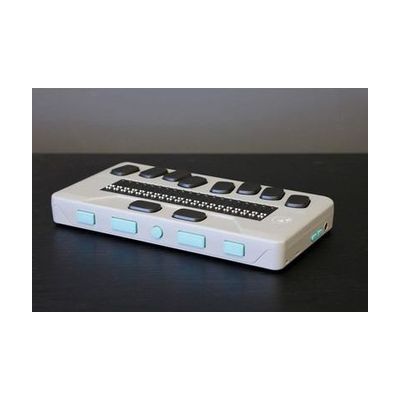
Chameleon 20
by American Printing House for the Blind
Price is what the vendor listed when last checked. Confirm it with the vendor before buying.
Last verified September 17, 2026 · classified May 23, 2026
What it is
Summary
AI-generated from vendor-published content · May 23, 2026
The Chameleon 20 is a 20-cell refreshable braille display with a built-in keyboard, text-to-speech, and onboard apps — including a text editor and accessible book library — so it works as a standalone note-taker, not just a peripheral. It's aimed at students and working adults who are blind or have low vision and want to build or maintain braille literacy while also getting real work done. This is a complete, self-contained device: no laptop or phone is required to use the built-in apps, though it can also pair with other devices via Bluetooth or USB as a standard braille display. File transfer to Mac via USB is currently broken — APH acknowledges this and recommends using a USB drive or SD card as a workaround, which is a friction point worth knowing before purchase.
Quick Facts Catalog facts · auto-generated
- AT Act lending
- Medicaid waiver
- Out of pocket
- School district
- Vocational rehab
What Setup Looks Like
- Out of the box
Power on and use the built-in editor and library apps directly — no pairing required. - With a guide
- Pair via Bluetooth to a phone, tablet, or computer for use as an external braille display.
- Load books or documents by transferring files via SD card or USB drive.
- Adjust speech and braille settings through the onboard menus — expect 30–60 minutes to configure preferences. See manufacturer support resources for detailed instructions.
- With professional help
- A Teacher of the Visually Impaired (TVI) or O&M specialist can integrate the Chameleon 20 into a braille learning plan and configure grade-level braille settings.
- For school or workplace deployment, an AT specialist may assist with network access, app configuration, and pairing with screen reader environments.
Getting it
Try Before You Buy
Devices like this are often available to borrow through your state's AT Act program — typically free or low-cost — so you can try it before buying or pursuing funding.
Where to Get It
This is the vendor WhatCanHelp tracks for this product — it may also be available from other retailers or a local supplier, and prices vary.
Some links may be affiliate links — WhatCanHelp may earn a small commission from purchases at no extra cost to you. More on affiliates →
As an Amazon Associate we earn from qualifying purchases.
How to Fund This
Equipment like this is often pursued through official state programs. These are common starting points — each program decides its own eligibility and what it covers, so the first step is always a phone call.
Compare & explore
Sources & fine print
Vendor facts (name, price, platforms, vendor link) sourced from American Printing House for the Blind — view on vendor site; last verified September 17, 2026.
Classification & description AI-generated from vendor-published content on May 23, 2026 · confidence: high. Vendor specs may lag; verify before relying on details in a clinical or funding artifact.