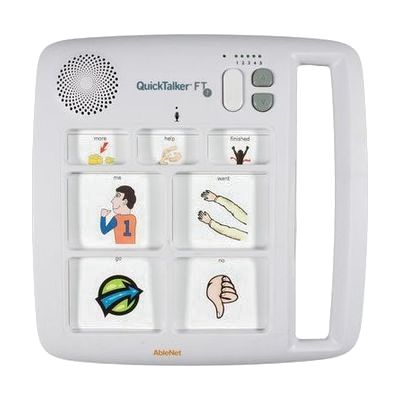
QuickTalker FT 7
Price is what the vendor listed when last checked. Confirm it with the vendor before buying.
Last verified September 16, 2026 · classified June 9, 2026
What it is
Summary
AI-generated from vendor-published content · June 9, 2026
The QuickTalker FT 7 is a dedicated multi-message voice output device with seven message locations — three that stay consistent across all recording levels and four that change per level, giving users up to five different context-specific vocabulary sets within 6 minutes of total recording time. It's designed for someone who needs a portable, low-tech AAC option for communicating basic wants, needs, and comments across different daily environments: classroom, lunchroom, home, or out in the community. The FeatherTouch membrane is a meaningful hardware difference — it requires substantially less activation force than standard overlays, which makes this a reasonable option for users with limited hand strength or fine motor control. This is a complete standalone device requiring no apps, tablet, or accessories to operate, though an SLP or educator should program vocabulary to match the user's actual communication needs and daily routines. Seven locations is a modest vocabulary set, so users who are ready to grow beyond basic phrase-level communication will likely outgrow this device fairly quickly.
Quick Facts Catalog facts · auto-generated
- AT Act lending
- Medicaid waiver
- Out of pocket
- School district
- Vocational rehab
What Setup Looks Like
- Out of the box
- Install batteries, press any message location to confirm the device powers on.
- Record a message by holding the record button and speaking into the built-in microphone for each cell.
- With a guide
- Plan vocabulary across all five levels for different environments (e.g., classroom, home, meals).
- Print and insert symbol overlays to match recorded messages for each level.
- Full setup across all five levels with overlays takes approximately 30–60 minutes. See manufacturer support resources for detailed instructions.
- With professional help
- A speech-language pathologist (SLP) or AAC specialist should assess whether this device matches the user's expressive communication goals and motor access needs.
- SLP selects core and fringe vocabulary, records or coaches caregivers to record messages, and trains communication partners on prompting strategies.
- Expect 1–2 sessions for initial programming and partner training.
Getting it
Try Before You Buy
Devices like this are often available to borrow through your state's AT Act program — typically free or low-cost — so you can try it before buying or pursuing funding.
Where to Get It
This is the vendor WhatCanHelp tracks for this product — it may also be available from other retailers or a local supplier, and prices vary.
Some links may be affiliate links — WhatCanHelp may earn a small commission from purchases at no extra cost to you. More on affiliates →
As an Amazon Associate we earn from qualifying purchases.
How to Fund This
Equipment like this is often pursued through official state programs. These are common starting points — each program decides its own eligibility and what it covers, so the first step is always a phone call.
Compare & explore
Sources & fine print
Vendor facts (name, price, platforms, vendor link) sourced from Inclusive Technology — view on vendor site; last verified September 16, 2026.
Classification & description AI-generated from vendor-published content on June 9, 2026 · confidence: high. Vendor specs may lag; verify before relying on details in a clinical or funding artifact.